


Still special
In 2022, industry leaders in Le Marche feared for the future of the artisan footwear and leathergoods companies that operate there. The region’s shoe and bag producers are still going strong.
In early 2022, optimism was on the up in leather and footwear. Covid-19 lockdowns were behind us and consumers were keen to get up, dress up and show up for work and social gatherings again. But when the war between Russia and Ukraine broke out, the mood quickly plummeted.
In March that year, on the first day of the Micam and Mipel exhibitions in Milan, exhibitors from Italy’s Le Marche region held a crisis meeting. Senior industry representatives from Le Marche immediately made it clear that their biggest desire was for the war to end quickly. But they also pointed out that Ukraine, Russia and another country caught up in the conflict, Belarus, had become important export markets.
At the time, export promotion agency ICE said that for Italy’s footwear industry, Russia, Belarus and Ukraine represented 3% of overall export business. But for the footwear industry in Le Marche, ICE said between 9% and 10% of total export revenues came from sales in those three eastern European countries. From a business point of view, this was why the 2022 Milan crisis meeting took place. Four-and-a-half years on, the war between Ukraine and Russia is still raging. It has resulted in more than 300,000 casualties so far. An end to this war, and all other ongoing conflicts, is still everyone’s top priority.
Returning to business concerns, however, manufacturers in Le Marche decided in 2022 that the best direction for them to take was to continue to present the special story of the fashion supply chain there. They are still telling that story today.
An eco-system on show
A delegation of brands and fashion advocates travelled to Birmingham in mid-August to present some of Le Marche’s secrets, travelling with officials from the region’s chamber of commerce. The brands hoped to make an impression on people arriving in the city from all over the continent for the 2026 European Athletics Championships.
Leathergoods brands taking part included Valentino Orlandi and Marta Gattari, while companies including Loriblu, Franceschetti, Alexander Hotto, Enrico Cuini and equestrian products specialist Romitelli Shoes held the torch for Le Marche’s footwear sector.
Luca Sabbioni, a creative director who works with several footwear brands in Le Marche, says there are more than 4,000 production companies working in the fashion supply chain in the region at the moment, employing a combined total of 35,000 people. More than 45% of what they produce goes to export markets and, together, the region’s producers of shoes, bags and clothes generate €2 billion in export revenues per year.
Most of these companies are small, Mr Sabbioni points out, but together they make up a fashion eco-system that he says is world renowned for its creativity, quality and craftsmanship. “It is 360-degrees,” he says. “We have quality, design, research institutions, material and component suppliers, and artisans who have acquired generations’ worth of skills.”
Difficult to replicate
Since 2019, Linea, a specialist company that works to promote this leathergoods, footwear and fashion expertise in international markets, has operated as part of Le Marche’s chamber of commerce. Linea chief executive, Francesca Orlandi, claims that what the region offers would be difficult to replicate anywhere else. “If designers come to Le Marche in the morning with an idea, they can have a prototype in their hands that same evening,” she explains.
Having the whole supply chain, a whole production district with specialists in materials, machinery and finished products all on hand, is what makes the difference, she believes. She says: “We also have originality and high levels of craftsmanship. Our district has evolved in the course of 100 years into a one-stop shop for world-class footwear and other products. We know how to make products that show what it is our customers want to express. Yes, you could buy machinery and set up a shoe company anywhere in the world, but you could not repeat what we have.”
The whole look
Designer Massimiliano Giangrossi is part of this world, specialising in couture clothing for women. But he makes the same point about the breadth and depth of what Le Marche can offer. “Clothes on their own do not work,” he says. “Customers need an entire outfit, with the jewellery, the bag and the shoes to go with the dress and complete the look. This is why it is so important to have the whole eco-system on hand and for us all to work together. And, because so many of the processes we carry out in making our products are done by hand, craftsmanship is essential. Therefore, we need young people to want to come into the industry and work with their hands.”
A luxury touch
At the same time, the industry in Le Marche insists it is open to change. Luca Sabbioni quotes studies that suggest that, when it comes to making a footwear purchase for the first time in their lives, 65% of young consumers today buy sports shoes. Only 13% of these consumers bought formal shoes as their first purchase. The same studies show that, in 2025, almost 90% of Gen Z consumers (people born between 1997 and 2012) bought at least one pair of sports shoes. More than 70% of them bought three pairs.
Responding to this, footwear companies in Le Marche are making more sports shoes, Mr Sabbioni says. “But the difference is that they are doing so using the knowledge, originality and materials, including beautiful leathers, that they have always used,” he explains. He calls these products “luxury sports shoes”, insisting that Le Marche manufacturers are bringing luxury, including the obsession with perfection that high-end producers must have, to the world of sports shoes.
Heel help
This cross-over between the demands of today and the world of traditional style and craftsmanship is two-way. One of the footwear brands taking part in the Birmingham event, Enrico Cuini, has the data to prove it.
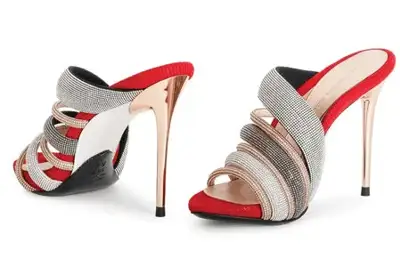
A Le Marche-based footwear designer who has worked closely with the brand, Gregory Baffoni, says founder, the eponymous Enrico Cuini, has made it his mission to make high-heeled shoes that women will find comfortable to wear. He holds up a shoe with a 12-centimetre heel. “It looked as though humanity was capable of sending astronauts to the moon, but not of making comfortable high heels,” he observes.
After years of studying the anatomy of the human foot, Enrico Cuini established a method of incorporating patented technology into the construction of his shoes. “This technology works by expanding the area at the heel of the shoe that provides support to the foot. It also supports the arches and distributes the wearer’s weight in the most efficient way possible.” He says that what the shoe looks like from the outside is completely different to the way it feels on the inside.
Made in Le Marche
The view of the president of Le Marche’s chamber of commerce, Gino Sabatini, is that events like the one in Birmingham are important for continuing to put across what the region can produce. He argues that there is “a beautiful reality” in the global phenomenon that is ‘Made In Italy’. “A big part of ‘Made In Italy’ is actually ‘Made in Le Marche’,” he says. “Important brands are coming to Le Marche to source their products.”
The ongoing wait for a resolution to the war in Ukraine and other armed conflicts is a cause for concern for peaceful people everywhere. This includes the citizens and business community of Le Marche. Something has changed, though, since those first frightening days in 2022. This same business community seems to have put behind it those early fears of severe commercial consequences. It has withstood the set-back of losing 10% of its export revenues overnight. Its confidence in its own products and manufacturers remains undiminished.
“Our companies have reacted well,” Gino Sabatini explains. “They have found other markets and have run good campaigns to win new customers there. Business that they were doing with customers in Russia and Ukraine has been replaced by business in the US or in south-east Asia. We also have some companies that have begun to work successfully in African markets such as Nigeria or South Africa. Others have been able to build up a presence in South America.”
He points out that Germany and France have long been the most important markets of all for Le Marche manufacturers. This remains true today, which pleases the leader of the region’s chamber of commerce. Something else that pleases him is that most of the operators in the fashion eco-system are still in business. “We have been able to limit business closures,” he says. “Support from our politicians in achieving that has been very welcome.”
Le Marche footwear brand Enrico Cuini has made high-heeled shoes that are comfortable to wear its mission. Credit: Enrico Cuini


