




Recycling: ‘challenging but possible’
Leading brands have supported Fashion for Good pilots to pool knowledge on circular thinking and search for solutions to the complex problems holding footwear recycling back.
Dutch sustainability hub Fashion for Good does a great job at uniting brands and the supply chain. It organises pilots addressing various challenges, helping to scale up, increase adoption or support with data novel materials and processes. Following seven years of focusing on textiles, in 2024 it announced a series of projects that would apply the research and collaborative development blueprint to the footwear sector, under a banner called Pioneering the Future of Footwear.
One of the biggest topics taking up headspace in the fashion industry is circularity – how can we keep materials in use for longer and recycle elements when they no longer serve their purpose? With an estimated 23.8 billion pairs of shoes produced annually, the vast majority of these ending up in landfill and less than 1% recycled, this is a question that needs some answers, compounded by incoming regulation such as Extended Producer Responsibility schemes, Digital Product Passports and stronger circularity requirements. This is a sticking point for shoe companies – not least because of the multitude of materials, glues and components that they work with. But also in a practical sense. How can shoes be collected and sorted in a way that makes both economic and environmental sense?
Collaborative working is the only way, Fashion for Good has concluded. At the start of last year, it launched Closing the Footwear Loop, which brings together 15 brands and four innovators to test ideas and pool resources, orchestrated by Dutch non-profit Circle Economy. It addresses the lack of end-of-life infrastructure, complex multi-material designs and the need for unified circularity approaches.
Fashion for Good describes its findings as the first large-scale, product-level dataset on non-rewearable shoes. “The footwear industry stands at a critical turning point,” says its managing director, Katrin Ley. “With billions of shoes produced annually and 90% ending up in landfills, 'Closing the Footwear Loop' represents our most ambitious effort yet to reimagine how we design, use and dispose of shoes.”
Adidas, Inditex, Otto Group, On, PVH Corp, Reformation, Target, Zalando, Arc'teryx Equipment, Coach, Dr Martens, Decathlon, Deichmann, Deckers Brands, Footwear Distributors and Retailers of America (FDRA), Lululemon, PUMA Group and Vivobarefoot are partners - demonstrating a healthy appetite from brands to gain some clarity.
Wheat from the chaff
The first phase of the study was conducted through research, stakeholder interviews and an on-ground analysis. Recycler Moda-re in Barcelona sorted 7,200 post consumer shoes, finding 4% cream [top] quality, 42% as Grade 2 quality rewearable, and 50% as non-rewearable. The best quality shoes are generally resold in Europe, with lower grades exported to countries such as Pakistan, UAE and India. The report noted the rise of peer-to-peer trading platforms means the most valuable shoes stay in that system, limiting the value for sorters. From this batch, 1,200 non-rewearable items were sent for analysis by CETIA, a French innovation centre dedicated to the recycling of fashion goods.
It is common practice to first shred and later identify and separate footwear materials, meaning that purification and classification is only possible after shredding. However, the team enlisted UK-based Matoha, which adapted its handheld infrared spectroscopy devices from clothing for this project. These machines take a reading before the shoe is physically broken down.
“In practical terms, this means shoes could be scanned at collection, sorting or disassembly stages to make faster decisions about reuse, resale, repair or recycling routes,” Chris Newton, Matoha’s chief commercial officer, tells Footwearbiz. “The benefit of rapid identification technology is speed and better decision-making. If operators can quickly understand what they are handling, they can sort materials more effectively, reduce contamination and potentially direct products into higher-value reuse or recycling streams.”
However, these devices face constraints with footwear. NIR scanners could not recognise 40% of the soles’ make-up. One of the main reasons is the inability to recognise carbon black, which does not reflect light that can be read by spectrometers, and which made up a third of the soles in the sample. The scanners also have problems with leather, due to the way the tanning process alters the surface, as well as any material that is heavily coated, or with thick prints, or blends of certain materials. Adhesives and dirt can also impact readings. In many cases, scanning specific exposed components or partially disassembled sections gives the best results, says Newton. “We see the technology as a powerful decision-support tool rather than a ‘magic scanner’ that solves every challenge instantly.”
Flies in the ointment
The complexity of shoes compounds the problem. A single running shoe can contain up to 65 parts assembled through more than 360 steps. In the sample, half of the shoes were bonded with strong adhesives, which prevents the clean separation and identification required for high-value closed-loop recycling. Even seemingly simple shoes combine multiple polymers, foams, textiles, rubbers and glues. Only 10% had midsoles and outsoles made of the same material, and those made from SBR (styrene butadiene rubber) and vulcanised rubber cannot be broken down chemically due to the crosslinkers. SBS (styrene-butadiene-styrene), TPU (thermoplastic polyurethane) and EVA (ethylene-vinyl acetate) are technically capable of mechanical recycling but need need to be isolated from adhesives and thermoset contaminants. All of these stages add time, energy and, crucially, cost.
In terms of disassembly, another major problem was noted: around 90% of shoes had external disruptors such as logos, patches and trims, and 22% of the shoes had internal disruptors including adhesives, metals, hardpoints and blended materials.
Added insight
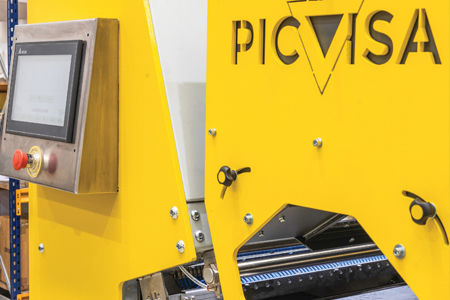
To complement the study, Spanish sorter Picvisa and French company The 8 Impact also conducted trials. To meet the requirements for Picvisa’s optical sorting machinery, a footwear sample was mechanically shredded and separated by density through machinery made by Eldan Recycling. At this stage, material loss varied depending on the type of shoe: for boots, around a quarter of the material was lost, but for performance shoes, this rose to 70%. The flakes were then sorted using Picvisa’s Ecoflake machine. Its study showed that while high levels of efficiency can be achieved under controlled conditions, significant challenges remain when dealing with complex waste streams; the shoes need better pre-processing and separating to gain more acceptable results.
Impact 8 gave a more positive verdict. The company is based near Lyon, and runs a successful line transforming old trainers and tennis balls into compounds for outsoles. Pre-sorting is conducted by collectors and social enterprises, ensuring consistency and low variability. Impact 8 shreds then separates the materials, recovering the rubber at a rate of 99% purity. This is ground to a fine powder that forms the base of the new soles.
It concludes “end-to-end sneaker recycling is technically viable, industrially scalable and capable of delivering recycled materials that are functionally competitive with virgin materials”. Recycled rubber and EVA could achieve price parity through volume and margin control, it says, but this requires early collaboration with design and supply chain teams as well as offtake commitments from brands and manufacturers.
First findings
At the start of this year, the Closing the Footwear Loop partners met at Adidas’ headquarters in Germany to discuss initial findings. Adidas, Decathlon, Footwear Innovation Foundation and Vivobarefoot shared their stories, and materials innovators pitched their products.
The first report from the project, published in June, concludes gains can be made from making shoes with fewer blended materials, avoiding black, using fewer heavy coatings, and reducing decorative disruptors. Data collection throughout the manufacturing processes will be essential to enhance sorting accuracy, it says. There needs to be infrastructure and system-level improvements for feedstock accessibility, including preprocessing, to enable component separation, contaminant removal and refurbishment. With a quarter of the unwearable shoes found to have no damage, there also need to be more education on the consumer side, with quick wins including tying shoelaces together when they are disposed of, so the pair doesn’t separate in transit.
Interviews are now being held regarding the design process to understand how visual guidance for stakeholders can be developed, and a pilot with disassembly specialist Idelam to separate out TPU/PU, EVA, leather and rubber using supercritical CO2 has been agreed. The teams want to work out how circularity can be designed in from the start, and how deeper connections can be made across the chain to enable collectors, sorters and recyclers to work more closely with brands.
“The path forward involves strengthening circular design practices, promoting the re-wear potential, improving sorting and preprocessing capacity and technology, and establishing robust data systems,” concludes the report. “Transforming non-rewearable shoes from a complex waste challenge into a valuable material resource is challenging but possible through collaborative intervention. By grounding policy and innovation in evidence, the footwear sector can take decisive steps towards closing the loop.”
The full report can be read on Fashion for Good’s website.
Picvisa’s ECOFLAKE optical sorting systems are equipped with high-resolution RGB cameras, NIR technology and a belt feed system, allowing for the separation of different types of materials and colours, with purity rates of over 90%. Credit: Picvisa






