




A new chapter for Bangladesh
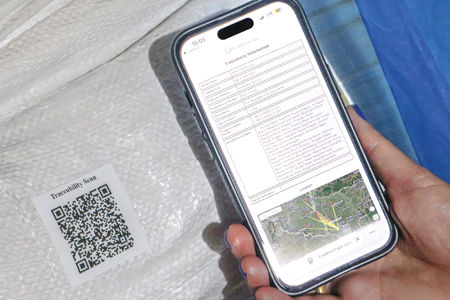
A traceability project in Bangladesh successfully tracked millions of square-feet of leather from source to footwear and other finished products.
A project called Leathertrace Bangladesh has come to a successful conclusion. Taking two years to complete, Leathertrace involved 11 leather manufacturers in Bangladesh, three finished product companies and more than 150 suppliers of hides and skins.
Working with academics from UK universities, non-profit organisation the Sustainable Leather Foundation, and technology and management partners in Bangladesh, the project leaders successfully traced almost 200,000 cattle hides and 3 million square-feet of finished leather. This included material that went into shoes and leathergoods for customers in Europe and North America. Leathertrace also had the support of the United Nations Trade and Development body and of the UK’s Foreign, Commonwealth & Development Office.
At an event in London at the end of June to mark the success of the project, which leathergoods brand Mulberry hosted, the managing director of the Sustainable Leather Foundation, Deborah Taylor, said: “Traceability is where we have to start from and Leathertrace has found a system that will work and will also scale up. The government in Bangladesh is working on a plan for the footwear and leather industry there. We want the work that has come out of this project to be part of that plan.”
Great expectations
Dhaka-based consultancy Idea Tree was one of the project partners. Its head of operations, Kauser Ali, worked as the main project coordinator for Leathertrace. Summing the initiative up, he says: “For two years we worked together on the transformation of the footwear and leather industry in Bangladesh to make it more transparent and more circular. We want this to help position Bangladesh as a global leader in sustainable production.”
He explains that the project partners were working to address global expectations regarding environmental compliance and responsible sourcing. “We built and tested a traceability platform,” he continues, “we explored circular-economy options and we have now developed a policy blueprint, which we hope will become an important resource for government policy-makers and industry leaders.”
This message seems to have landed already with the country’s ministry of commerce. Joint-secretary, Mostofa Jamal Haider, insists that footwear, leather and leathergoods can play an ever-greater role in the development of Bangladesh. “We want to establish Bangladesh as a responsible sourcing destination,” he says. His colleague and fellow joint-secretary, Nargis Mushida, explains that the footwear and leather sector is the second-largest earner of export revenues that the country has, behind ready-made garments. “We want to move forward,” she says, “and to increase our industrial capability. To do this, we need stronger digital systems, we need good policies and we need our international partnerships to continue.” Her belief is that Leathertrace will help Bangladesh move forward on all these fronts.
Distant second
However, from an industry perspective, the managing director of Apex Footwear and current president of the Footwear Leathergoods and Accessories Exporters’ Association (FLAXA) of Bangladesh, Nasim Manzur, points out that the footwear and leather sector is, in fact, a very distant second to garments at the moment. “Our ready-made garments industry has export revenues of around $45 billion per year,” he says. “We are the second-biggest contributors, but we are at a level of around $1.5 billion. Bangladesh desperately needs to diversify and lower its dependence on the garment industry. We hope that the blueprint that the Leathertrace project has produced can help to make growth happen for the footwear and leather industry.”
The United Nations placed Bangladesh on its list of Least Developed Countries (LDCs) in 1975. Its graduation from that list is overdue. Following delays caused by covid-19, it should cease to be an LDC in the next few years. The benefits of being an LDC include preferential trade access to some markets. When a country graduates from the LDC list, as Bangladesh is about to do, it leaves some of that preferential treatment behind and has to be ready to compete on its own terms. “We are going to graduate from that group in the next two or three years,” Nasim Manzur says. “If we don’t diversify, we could be in trouble.”
Further funding
His FLAXA colleague, Ibnul Wara, who is managing director of leathergoods manufacturer Austan, says the Leathertrace project proves what is possible in Bangladesh. But he insists that “piloting is over now” and that it is “time to scale” and that the private sector’s commitment to this is absolute. Private-sector partners are willing to fund the running of Leathertrace for a further six months, while additional partners come on board.
Mr Wara’s company is a long-standing supplier to German leathergoods brand Picard, which has been sourcing in Bangladesh since the mid-1990s. He accepts there is still work to do but he also argues that some assumptions international companies make about Bangladesh are misplaced. He says: “When we talk about supply chain traceability in the leather sector, we often look at it through the western lens of organised farming and formal slaughterhouses. This is not what we have in Bangladesh. Hides in our country travel through a complex web of multiple hands before reaching the tannery.”
Untold story
And yet Bangladesh has what he calls “a unique, beautiful story that often remains untold”. Cattle there are not mere commodities but are reared by families in small villages as part of their households. “These animals are often treated with more care than you can imagine,” Ibnul Wara explains. “For example, families will often put mosquito nets over their cattle while doing without that protection themselves.”
On becoming part of the Leathertrace project, his view was that bringing traceability “to such a fragmented sector” would be almost impossible, but when he saw a demonstration of the digital platform, he says he was “blown away”. Austan is a handbag manufacturer with its own leather finishing unit. Until now, the managing director says, its traceability efforts ended at the point of crust sourcing. “Today, thanks to Leathertrace, our products can be traced all the way from the slaughterhouse to the finished products that we export all over the globe,” he adds.
He calls this the beginning of a new chapter for Bangladesh. He admits to being very excited about it. “Traceability is no longer a luxury or an option,” he concludes. “It is a strict mandate for market access.”
Leathertrace in action. A scan of bovine leather at the Mitali tannery in Bangladesh flags up the slaughterhouses the hides came from. Credit: Leathertrace






