



The beauty of calf leather
Calf leather remains a benchmark material in luxury footwear, valued for its fine grain, softness and performance. This feature explores the qualities, sourcing challenges and craftsmanship behind this premium leather.
In luxury footwear, leather remains the defining upper material, but it is far from a single, uniform category. The terminology used to describe it is often complex, with terms such as full grain, top grain, corrected grain and aniline describing differences in surface treatment, finishing level and visual character rather than fundamentally different raw materials.
Among these categories, calf leather occupies a unique position. Produced from the skins of young cattle, it is valued for its fine grain, uniform appearance and balance of softness, flexibility and durability. These characteristics have made it one of the preferred materials for premium footwear uppers, particularly where refined aesthetics, comfort and long-term wear performance are essential.
Unlike adult bovine hides, calfskins come from animals that have experienced a shorter period of growth, resulting in a finer collagen fibre structure and a more compact grain layer. Like all bovine leather, calfskin is a by-product of the meat industry, but these age-related characteristics place it in a distinct category within the footwear market.
Why footwear brands choose calf leather
For premium footwear manufacturers, calf leather remains difficult to replace because it combines aesthetic qualities with practical performance. Duncan Stuart, leather buyer at English footwear manufacturer John Lobb, says calf leather remains central to the company’s footwear production, with both box calf - a firm, smooth and highly polished full grain aniline leather - and calf suede used across classic and more casual styles.
One of the defining characteristics of calf leather is the way it behaves during wear. Its tighter fibre structure helps create a clean break over the flex point of the shoe, reducing the risk of the loose, "pipey" creasing that can develop with more open-fibred leathers.
According to Mr Stuart, "calf leather will have a good tight break where the foot bends. There will be no 'pipey' appearance after a short time as calf has tight fibres in the core of the skin."
Its fine grain also provides an ideal surface for polishing, making it particularly suited to formal footwear where appearance is critical.
From a manufacturing perspective, consistency and workability are equally important. Mr Stuart explains that the company primarily uses natural aniline-finished calfskins, which offer a more authentic surface character but require careful selection and cutting because natural markings such as scars, flaws and veins remain visible.
Softer calf qualities are preferred for lasting, allowing the leather to form around the last more easily while reducing the risk of grain cracking. The choice of calf leather also influences comfort, with manufacturers looking for a rounded handle that allows footwear to achieve a shorter break-in period.
Working with minimally finished aniline leather does require careful production control, particularly when dealing with colour variation between skins. Components must be cut strategically, with areas such as shoe fronts taken from the stronger butt sections of the skin, helping to minimise stretch and maintain consistency between pairs.
Fibre structure and performance
The reputation of calf leather is intricately linked to its fibre structure. Compared with adult bovine hides, calfskins have a finer and more tightly packed collagen network, creating a tighter grain layer and a smoother surface character.
However, achieving consistent grain quality depends not only on the raw material but also on careful processing. The relationship between the grain and corium layers is critical, as differences in flexibility and response to chemical and mechanical treatments can influence the final appearance and performance of the leather.
Excessive mechanical action, over-aggressive swelling during liming or poorly controlled fibre opening can affect grain integrity, while insufficient conditioning or fatliquor penetration can influence softness and flexibility. The challenge for tanners is to preserve the natural tightness of the fibre structure while achieving the handle and performance characteristics required by footwear manufacturers.
When successfully processed, calf leather delivers a fine grain break and smooth, consistent surface, particularly in lightly finished and aniline grades. This combination of natural structure and controlled processing remains central to its appeal in premium footwear.
Sourcing calfskins
The availability of premium calfskin has become an increasingly important consideration for footwear manufacturers and leather buyers, with supply influenced by agricultural trends, climate conditions and changing quality expectations.
Speaking at the 2024 Sustainable Leather Forum in Paris, Nick Winters, past-president of the International Council of Hides, Skins, and Leather Traders Associations (ICHSLTA), highlighted the growing pressure on calfskin supply. He noted that annual calfskin availability in France, one of Europe's most important sourcing markets, had fallen by around 600,000 pieces over the previous decade, with total volumes unlikely to exceed one million skins per year, compared with approximately 1.6 million a decade earlier.
These pressures continue to be felt throughout the supply chain. Chris Smith, a leather specialist and sourcing consultant with extensive experience in calf leather, says reduced hide availability is translating directly into a smaller pool of premium-quality material.
"That is exactly what is happening over the whole of Europe. Less hide availability translates into less quantity of premium quality hides. The quality of the hides has also dropped."
Mr Smith adds that only a small proportion of available calfskins are suitable for the highest-end footwear applications.
"From a pallet of calf hides only 5-10% will be suitable for high-end calfskin users."
For those seeking premium footwear grades, selection begins with careful consideration of size, grain quality and fibre consistency. Mr Smith says calfskins in the 16-22 sq ft range are particularly suitable, as he finds the grain to be finer and the fibre structure more consistent across the entire skin.
Traceability has also become an increasingly important factor in premium calf leather supply chains. Mr Smith says he works with suppliers that process from raw material through to finished leather, providing a complete history from slaughterhouse to final product. However, he notes that some of the biggest challenges remain between farm level and tannery arrival.
Alongside availability, climate and farming conditions continue to influence raw material quality. Longer and warmer summers increase the likelihood of insect damage and more pronounced vein structures, reducing the availability of clean skins suitable for minimally finished footwear applications.
The characteristics of available material are also closely linked to production systems. French calves are typically reared under controlled indoor conditions and fed on milk for approximately four to six months, helping to minimise external damage and surface scarring. These conditions contribute to the clean appearance and grain quality valued by luxury footwear manufacturers.
Differences can also be seen between origins. Duncan Stuart notes that Dutch skins tend to offer larger sizes and good cleanliness, while French skins are often considered an ideal size but can contain more visible veins. Swiss calfskins are noted for having fewer vein-related issues, while seasonal variations can also influence quality, with winter skins often showing reduced vein visibility.
Producing calf leather
The heritage of premium calf leather production is closely linked to the development of specialist European tanning expertise. Over generations, European tanneries have refined processes to produce the fine, consistent leathers demanded by luxury footwear manufacturers, particularly in areas such as grain control, finishing and colour uniformity.
The evolution of calf leather production reflects the wider development of industrial tanning, with the introduction of chrome tanning in the late nineteenth and early twentieth centuries marking a significant turning point.
Based on trivalent chromium (Cr III) salts, chrome tanning reduced processing times significantly compared with traditional vegetable tanning methods, while delivering softer, more flexible and more hydrothermally stable leather. Chrome tanning remains the dominant approach for calf leather destined for footwear due to its ability to deliver softness, water resistance, colour uniformity and a wide range of shades. Chrome tanning combined with smaller amounts of vegetable retanning is also used for specialist burnishable calf leathers, where the aim is to develop a natural patina and greater character through years of wear.
One of the continuing challenges in premium calf production is managing the balance between natural material characteristics and increasingly demanding footwear specifications. Growth marks and veins, for example, are natural features of the skin rather than defects from a leather perspective, but they become increasingly challenging as footwear designs move towards larger unbroken leather panels and customers expect near-perfect surfaces.
This challenge reflects the wider reality of calf leather production. Calves are primarily bred for meat production, meaning leather remains a valuable but secondary output. Breeding priorities are therefore focused on meat efficiency rather than leather characteristics.
The premium benchmark
Despite increasing pressure on raw material availability and growing interest in alternative materials, calf leather continues to occupy a unique position within premium footwear.
Its combination of fine grain, clean break, comfort, workability and finishing potential remains difficult to replicate consistently. As footwear brands continue to balance performance, aesthetics and responsible sourcing, calf leather remains the benchmark against which many premium upper materials are measured.
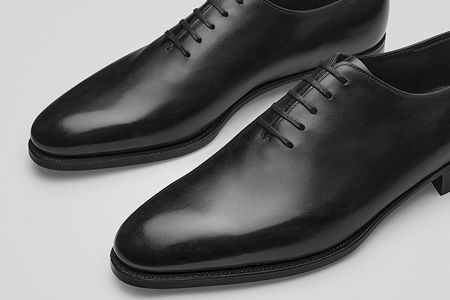
Single-piece uppers highlight the uniform grain and refined surface characteristics that have made calf leather a benchmark material for luxury footwear. Credit: John Lobb





