


Mixed message
Luxury group Kering has set out its vision for the future. The message to suppliers and buyers of leather products, including footwear, was mixed.
Seven months into his tenure as Kering chief executive, Luca De Meo, says the time has come for him to set out a plan for the years ahead. He came into the role in September (after being announced in February 2025) and has carried out, with senior colleagues, “a brutal diagnosis” of the way the group and its brands work. Decisive actions, spelled out in great detail at a capital markets presentation in Florence in April, will follow. These will affect the way Kering sources and uses leather. Some of the messages about this are positive from the leather industry’s point of view, but others are a source of serious concern. Kering loves and needs leather, but seems to wish it didn’t.
Mr De Meo says the measures and targets he and his team have come up with are in keeping with what he calls the entrepreneurial spirit that Kering has always had. In his opinion, the group, founded by the Pinault family in 1962, can tell “one of the most remarkable entrepreneurial success stories in Europe”.
The Pinaults began as Breton timber merchants, but moved into retail at the end of the 1980s, specialising first in furniture, then department stores, then books and electronic gadgets. Important early acquisitions included Conforama, Printemps and FNAC. In 1999, the group, then known as PPR, acquired a controlling stake in Gucci. That same year, it purchased 100% of Yves Saint Laurent. Investment in Bottega Veneta and Balenciaga followed soon after and the group became a major player in the luxury sector. It changed its name to Kering in 2013.
Risky business
“Twenty-five years ago we were a French retail group,” the new chief executive says. “Today, we are a global, luxury powerhouse. This transformation did not happen by chance. It happened because the Pinault family dared to take risks, to believe in creativity and to scale it.”
Revenues scaled steadily too until a peak of €20 billion in 2022, with Gucci contributing €10.5 billion towards the total. These figures fell to €19.6 billion and €9.9 billion in 2023, then to €17.2 billion and €7.7 billion in 2024, and to €14.7 billion and €6 billion last year. It was on the back of this that the group brought in Mr De Meo, most of whose career until then had been in the automotive sector. He says that he was fully aware of the challenges Kering faces when he took the role, insisting that he remains convinced of the strength of its brands and of the group’s ability “to reinvent itself”.
Turning point
What this reinvention of Kering will involve and what the group and its products will look like at the end of the process is what Luca De Meo has now laid out. “Even the strongest stories reach turning points,” he explains. “Today we are at one of those turning points.”
He thinks this applies to the whole sector. After what he calls “a decade of exceptional growth” the entire personal luxury industry now faces a reset. The market has been flat since 2023, or even trending in a “slightly negative” direction, he says. The market in China has contracted by 20% over the same period, and the longed-for rebound has not yet materialised. But he also accepts that Kering has been “more severely impacted” than most of its peers. “The financial consequences have been significant,” he adds. Reasons that he has identified for this heavy impact include an over-reliance on attracting “aspirational customers” and the group’s brands being too “designer-led”.
In his opinion, luxury is a perception. The word he uses to sum up what truly matters to him is excellence. “Excellence is a discipline,” he explains. “Excellence must be earned every day, in every detail, across the entire value chain. At Kering, excellence will mean creativity, but also flawless execution. It will mean exceptional products, excellence in craftsmanship, quality, service, sustainability, technology and decision-making.”
The chief executive argues that it is excellence that “legitimises luxury”. What he means is that brands and retailers can apply the term luxury to any product, from breakfast cereal to soap. For consumers to accept that the label, and the increase in price it is likely to lead to, are justified, you have to offer excellence.
Kering’s model for putting this into practice is no longer effective, and he and his colleagues have come to the conclusion that a new, streamlined group platform is necessary. This will be structured around five hubs: industry, customers, technology, sustainability and support functions. Perhaps these are self-explanatory, but it is worth adding some extra information.
AI’s role
The technology hub will make extensive use of artificial intelligence (AI). In March, Kering recruited Pierre Houlès as its new chief digital and IT officer. For the last ten years, Mr Houlès has held senior digital transformation roles in automotive, working alongside Luca De Meo. At Kering, he will also have chief AI officer in his job title.
AI will help streamline operations and enable what Luca De Meo calls “productivity insights”. The information Kering teams gather from AI will support better decision-making, he says. For example, AI will have a role to play in helping the group manage inventory.
It began an inventory reduction exercise in September and is aiming to decrease the value of unsold stock by €1 billion within 12 months. This is not going to be a one-off, the chief executive continues, but the launch of “a complete change in the strategy for how we manage inventory”. Gucci, for example, has already reduced the range of products it offers by roughly 20%, Mr De Meo says. AI’s role will be to help with forecasting demand sooner in the process so that the group’s inventory management can be “leaner and more productive”, as well as more sustainable.
Non-negotiable
Sustainability is an aspect of the business that Mr De Meo describes as “non-negotiable across all disciplines”. This includes sourcing. Simplifying the way the business organises itself will bring clarity, help the balance-sheet, restore resilience, give more accountability and accelerate decision-making, he continues. However, all of the group’s brands will remain responsible for their own creative direction, product development, go-to-market strategies and “brand expression”.
The group ended 2025 with 1,719 stores across its own retail networks. This year, there will be 100 net closures, at least. City by city, the strongest stores will remain; others will close. There will be, according to Mr De Meo, “fewer doors, but better doors and higher productivity”. There will be openings too, with serious investment going into flagship stores, including one for Bottega Veneta in Bangkok, and in the Gucci flagship on the Avenue de Montaigne in Paris.
Brand by brand
Leathergoods and leather shoes will continue to feature prominently in these stores but, as mentioned above, Luca De Meo’s messages about leather are mixed. Yes, he says he wants to build “a more iconic leathergoods offer” across the Kering portfolio of brands. This will be driven by “a strengthened Gucci proposition”, for example, and by an expanded high-end offering at Saint Laurent and Bottega Veneta.
The group has set out pathways for all of its brands. At Gucci, bags will become “more functional” and shoes will offer “great comfort and durability”. Gucci’s most iconic bags will become more and more important. These products represent around 10% of all Gucci leathergoods today; this should increase to 20% by 2030. The corresponding target for Saint Laurent is for its most iconic bags to contribute 30% of the brand’s total leathergoods revenues by 2030. “Leathergoods is a strategic, key pillar for Saint Laurent,” Luca De Meo says. He adds that men’s collections from Saint Laurent have “significant untapped potential” and that the brand will “reassert its offer for men”, including in shoes.
He refers to Bottega Veneta as one of the most desirable luxury brands “among those who truly know”. Its next chapter will be about scaling this desirability, but without compromising the essence of Bottega Veneta. This essence, he explains, is to have an ethos of discretion, restraint and self-confidence and still to be “the ultimate symbol of luxury craftsmanship in leathergoods”. His aim is for Bottega Veneta to achieve steady growth between now and 2030, but adds that “to unlock its true potential”, the brand will expand beyond leathergoods and will build footwear and ready-to-wear collections too, for men as well as for women. He wants the brand’s revenues from products other than leathergoods to double by 2030.
Balenciaga he describes as a brand that has particular relevance for Gen Z. This generation will account for 20% or 25% of the global luxury market by 2030, the Kering chief executive says, compared to 14% today. “Leathergoods is quickly becoming one of Balenciaga’s most powerful engines for growth and its importance will continue to increase,” he adds. Year-to-date in 2026, leathergoods revenues at Balenciaga are already up by 20%. The brand will double its leathergoods business by 2030 and will “reinvent its men’s shoes category”. For women, too, he hopes for greater cross-selling from Balenciaga handbags into shoes and ready-to-wear.
Kering reports McQueen’s results as part of a segment it refers to as “other brands”. In 2025, these brands brought in €2.9 billion, down by 10% year on year. The group has said losses at McQueen “weighed on profitability, despite ongoing deep restructuring efforts”. Mr De Meo confirms that by the end of 2026 McQueen will have 50% fewer stores than it had at the end of 2025. The total number of stores the brand has worldwide is around 130, including 22 in China. The Kering chief executive describes this as “right-sizing” the number of McQueen stores. He says the group wants the London-based brand to “reconnect with its essence”. He adds that this should include making sure its shoes also reflect “the bold McQueen identity and its uncompromising spirit”.
Evolving client expectations
All of this sounds like good news for the leather and footwear industry, but there is a painful flip side. This is partly because the number of suppliers Kering works with is going to reduce. There will be winners and losers. The group calculates that it has 4,200 direct suppliers, but also that 98% of the products and services it buys comes from just 25% of those suppliers. This creates complexity, cost and risk, Mr De Meo says. Instead, it will now put in place a new sourcing set-up, built on a preferred-supplier model. It will select these preferred suppliers by their ability to meet all quality requirements while complying fully with social and environmental standards. They must also have agility and the capacity to innovate. The aim, he explains, is to move away from “short-term, transactional relationships” towards multi-year partnerships.
The really confusing part of Luca De Meo’s message is that, even as he repeats that leather will remain “central to Kering’s identity”, the group intends to diversify its material portfolio and to achieve a reduction in something it calls “leather intensity”. The chief executive explains: “We will measure this intensity as the number of square-metres of leather Kering purchases for each €1 million in revenues it brings in from leathergoods and shoes.”
If we understand this correctly, he means that he wants Gucci, Bottega Veneta, Saint Laurent, Balenciaga, McQueen and other Kering brands to achieve growth in their revenues, including (especially, even) their revenues from footwear and leathergoods. But he wants them to achieve this while consuming less leather. He wants this leather intensity to reduce by 30% by 2028.
It could meet this target by putting its prices up by 30%, or by reducing the size of bags by 30%. After all, if, say 1,000 square-metres of finished leather makes x bags that sell for y, Kering could source the same amount of leather, but alter the number of bags it makes from the material to x plus 30%. This would bring in revenues of y plus 30%. Job done; leather intensity reduction target achieved. But this is not how Luca De Meo presents the idea.
Worryingly, what is behind it seems to be “evolving client expectations, client pressure and animal welfare considerations”. Concern over this leads the chief executive to say: “This requires us to broaden our material universe. We want to reduce our dependency on constrained resources. We want to decouple growth from leather dependency.”
Perhaps Luca De Meo has not seen the facts and figures that show the leather industry can have no influence on how many head of cattle farmers raise. Perhaps he has not heard that demand for leather is down while hundreds of millions of hides continue to accrue anyway, or that letting hides go to waste instead of turning them into leather creates millions of tonnes of extra, unnecessary greenhouse gas emissions. Perhaps no one has told him that the value that skilled tanners, footwear artisans and other craftspeople can add to a hide is more than 5000%. Perhaps it has not occurred to him that leather is the very antithesis of a constrained resource.
Kering has its own material laboratory. It intends to use this resource to accelerate “next-gen materials”. Perhaps some new material will emerge, one that is renewable, natural, sensual, repairable, durable, long-lasting, sustainable, versatile, biodegradable, affordable and made from raw materials that will continue to accumulate whether Kering’s suppliers use them or not. And if not, perhaps it will decide that it really does love leather after all.
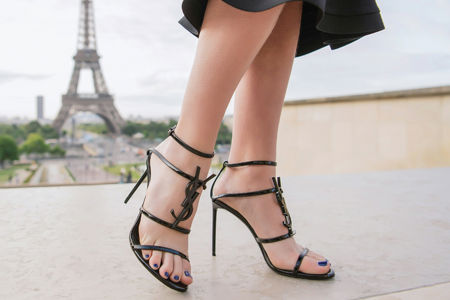
Leathergoods is “a strategic, key pillar” for Saint Laurent. Credit: The Paris Photographer/Unsplash






