




TPU sole with rubber soul
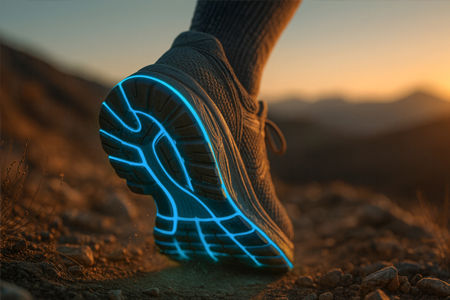
BASF says Elastollan GripTec gives designers greater freedom and manufacturers an easily integrated, lower-footprint alternative.
Germany-based chemicals and materials giant BASF was seeking to answer a simple question when developing its latest product for the footwear sector. Its chemists asked themselves, “Why only rubber?” when it comes to outsoles. The challenge was to create an alternative that could expand on design possibilities but which could also potentially lower the environmental footprint.
At plastics-focused trade show ChinaPlas in April, BASF’s Performance Materials Division unveiled Elastollan GripTec, part of its expansive thermoplastic polyurethane (TPU) portfolio. The new series combines grip, durability and design flexibility and has been created for outsoles of running and hiking shoes, as well as fashion and children’s footwear. “Footwear brands are always looking for materials that enhance user experience and improve safety,” says Rohit Roop Ghosh, a vice-president in the TPU division at BASF. “Elastollan GripTec enables greater design flexibility and advances our commitment to sustainability.”
To address diverse application requirements, the series comprises three grades. The first focuses on abrasion resistance with excellent durability; the second, a rubber-like feel with better transparency; and the third, greater transparency with a balanced performance profile. “However, there’s more to GripTec than grip and durability,” explains Cooper Li from BASF China. The variations in colour – from transparent to black – allow for more creative and detailed outsole designs, he says. “GripTec gives designers the freedom to shape outsoles the way they actually want to. Sharp textures, bold lines, clean patterns and, if a concept calls for it, transparency.”
From a manufacturing perspective, the GripTec series has been developed for optimised processability, which helps improve productivity, reduce energy consumption and minimise waste, according to the company. “GripTec runs on standard TPU injection processes, so shifting from rubber isn’t disruptive,” adds Cooper Li.
Its sustainability credentials are a third benefit, he suggests. A life cycle assessment (LCA) study conducted by Intertek showed that Elastollan GripTec generates around a 40% lower product carbon footprint than conventional rubber outsoles during the manufacturing stage. “Preliminary feedback from leading global footwear brands have been positive and validates the market potential,” adds Mr Ghosh.
Collaboration and circular thinking
Elastollan, first developed in the 1970s, has been a key product for the footwear sector. Its mechanical strength, resistance to abrasion, slip resistance and modifiable hardness mean it is suitable for a range applications. Soft grades are used for cushioning elements, medium hardness grades are suitable for compact or combination soles and hard grades work for heels and heel tips. Anti-static agents can also be added so that it can be used for safety footwear.
French outdoor brand Salomon launched a midsole with it using supercritical fluid (SCF) foaming technology for its Index.02 model in 2023. The SCF technology makes post-consumer recycling a possibility, as no crosslinking or chemical blowing agents are needed during the foaming process.
This kind of circular thinking was behind some of the new products that BASF presented at last autumn’s Simac footwear technology trade fair in Milan. A meltable PU means bottom units, upper parts or even complete shoes made of meltable PU or combinations of TPU and PU can be ready for mechanical recycling. Its new TPU Elastollan RC, with up to 100% recycled content, was also presented as a raw material for new shoe parts. Alongside this concept, it suggested that by using depolymerisation, both post-industrial and post-consumer footwear waste can be incorporated into new polyurethane shoe soles. Alternatively, ChemCycling (see sidebar) means it can incorporate up to 100% attributed recycled feedstock using a mass balance approach.
At the Milan fair, it also presented two collaborations with footwear technology providers, based on a new PU called SpringPURe, which emulates “the bouncy flexibility of polyether-based materials and the easy processing of polyester-based options”. A partnership with Italian machinery company Stemma, using its Nucleoos technology for chemical-physical foaming, created lighter midsoles with “outstanding style and performance”, and which integrates into existing polyurethane molding processes. It also launched direct soling concepts with Germany’s Desma, combining Elastopan SpringPURe lightweight midsoles with Elastollan TPU film outsoles.
BASF says innovation has always been the key to its success. In 2024, around 10,000 employees worldwide were working in research and development and it generated sales of around €11 billion with products launched within the past five years. Its annual R&D expenses amount to around €2 billion.
“What we’re seeing today is how complementary material innovations open up new design and performance possibilities while established materials like rubber continue to play an important role where they make most sense,” says BASF. “What’s changing is the range of options designers now have to balance grip, durability and design freedom.”
The Elastollan GripTec TPU portfolio is engineered to deliver superior traction, rugged durability and excellent abrasion resistance across a wide range of conditions. Credit: BASF






