




Complex combinations
Technology provider Trinamix has developed a system that can see through the “complex material combinations” in contemporary footwear and make shoes easier to recycle.
A provider of sensing technologies, Trinamix, has said a spectroscopy system it has developed can help the footwear industry put in place circular solutions for material recycling.
Ludwigshafen-based Trinamix is a subsidiary that chemicals group BASF set up in 2015. It has developed mobile near-infrared (NIR) spectroscopy technology that it says can support manufacturers, sorters, recyclers and brands in their efforts to identify the materials in shoes at end of life.
This, the company has said, can enable informed decisions in recycling and circular-economy processes. Using NIR spectroscopy technology will improve material separation and quality-control tasks when footwear arrives at recycling centres. Brands and manufacturers will also be able to use the technology at product-testing stage to examine and, if need be, improve the “recycling readiness” of their products.
No escape
Modern footwear consists of what the technology provider has described as “complex material combinations and blended structures”. This, it points out, is happening at a time when regulatory requirements and sustainability targets are increasing the demand for reliable and traceable material data. In Europe, at least, there is no escape from this.
Since the start of 2025, European Union (EU) member states have had an obligation to separate textiles from general waste collection. This is to prevent materials going to landfill and, instead, make them available for reuse and recycling under the EU’s Waste Framework Directive. Each of the 27 member states has its own national implementation programme. Some of these programmes, most notably France’s, already include footwear.
The Commission is currently working on formal revisions to the EU Waste Framework directive and a mechanism the footwear industry is already familiar with, Extended Producer Responsibility (EPR), will be part of this revision. EPR is a legal mechanism that will require companies placing footwear on the EU market to finance and organise the collection, sorting, reuse and recycling of those products at end of life. National schemes for putting this into effect are already in the works. By 2028, they will be mandatory. Footwear brands that are not already preparing collections for 2028 will be very soon.
Beyond the visual
“Material innovation is driving the future of footwear, but it also increases complexity across the value chain,” says circular economy lead at Trinamix, Adrian Vogel. “NIR spectroscopy provides a practical tool that can help customers increase transparency, minimise risk and take informed decisions in recycling and circular-economy processes.”
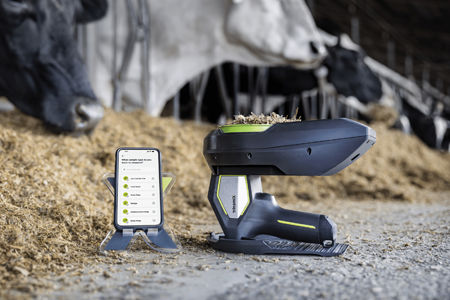
Trinamix argues that technology of this kind is going to be needed because visual inspection alone is no longer enough to determine the material composition of a shoe. Its solution combines a handheld spectrometer with a mobile app and a cloud-based data platform. The spectrometer, the trinamiX PAL Two, enables fast measurement even in demanding environments, the company insists. The mobile app takes users through the measurement process and delivers easy-to-interpret results.
Mind the gap
NIR spectroscopy is technology that is in use as an analytical method in a wide range of industries. Trinamix has worked with testing services provider Eurofins to apply the system it has built to help livestock farmers prepare feed mixes that meet the specific nutritional needs of their animals. Spectroscopy can analyse silage, for example, and help farmers see if there are “nutrient gaps or imbalances” in the plant matter. If there are, the farmers can provide the necessary additives.
There are human healthcare applications in the pipeline too. The company is confident that, in the near future, we will be able to use a smart phone or wearable device to measure aspects of our health just by quickly scanning our skin. Clinical studies have already taken place to establish the technology’s suitability for measuring alcohol levels in a person’s blood, for example. Using spectroscopy is a non-invasive method for carrying out these tests, the company argues, and the results are quick and easy to access.
Good vibrations
In Trinamix’s words, NIR spectroscopy “provides insight into the molecular composition of an object”. At the push of a button, a light source in the handheld spectrometer sends out NIR light. This light goes through the object’s surface and “causes the underlying molecules to vibrate”. Some of the light is absorbed, but some of it is reflected back and can be captured by a sensor in the spectrometer and transformed into an electronic signal. This signal has a pattern, or a spectrum. The spectrometer sends each spectrum to the cloud where “advanced chemometrics” evaluate it. Models compare the pattern with archived results. When the system finds a match, it sends the result to the app, telling users which materials are in an object or sample, and how much of them.
Along the recycling chain, the PAL Two has already proved its ability to identify different kinds of plastic “on the spot”, leading to improved accuracy and efficiency in sorting. In announcements it made in 2025, Trinamix said the handheld spectrometer and the cloud-based data platform had already shown themselves to be capable of identifying 30 different types of plastic, including polyamide, polyethylene, polypropylene and polyvinyl chloride. It was also able to identify textile fibres, including cotton, acrylic, elastane and wool.
It has carried out live demonstrations of the technology at a number of industry exhibitions in the last 12 months. What gives Trinamix extra confidence that the system will work well with the “complex material combinations” in use in the footwear industry is that it has successfully recognised “hard-to-differentiate plastics and textiles”.
Materials on this list include blends of polyethylene and polypropylene. Until now, these combinations have posed what it calls “significant challenges” when products containing them go for recycling.
A further point the company makes is that compostable plastics, which are in use in some footwear and footwear components, offer an environmental advantage but can “complicate sorting processes”. This is especially the case when the compostable materials resemble conventional plastics. “Polyamides like PA 6 and PA 6.6 are often difficult to separate and recycle, further complicating waste management efforts,” Trinamix says. Its system can identify all these materials and, it insists, help close the loop in footwear sustainability.
The Trinamix system uses a handheld spectrometer, cloud-based data platform and app to go beyond the visual and tell users which materials are present in any object, from cattle feed to footwear. Credit: Trinamix






