




Raw material quest
Leather’s appeal remains strong for Turkey’s footwear industry, in spite of important changes in the domestic supply landscape.
Analysis of the leather industry in Turkey makes it clear that footwear is the most important market for the sector. However, the ongoing strong performance of shoe companies in Turkey has coincided with a contraction in domestic leather production. As a result, footwear companies are now looking beyond the country’s borders to supplement the supply of their key raw material. And, as we shall see, they are now willing to spread their search quite widely.
At the start of 2026, a peer-reviewed academic publication in Turkey, the Journal of Innovative Engineering and Natural Science, published in-depth research into the domestic leather sector. The paper’s author was Kemal Kilinç, an academic based in Bolu, close to Gerede, one of Turkey’s main leather-producing centres. The paper includes analysis of leather-sector exports over the first years of this decade. Footwear exports average 58% of the total share of the wider industry’s export revenues across that period. This compares to 21% for leathergoods, 12% for finished and semi-finished leather, and only 9% for a segment Turkey is particularly renowned for, leather garments. The most recent year that the Kilinç paper gives a value for is 2022, when footwear exports brought in $1.3 billion.
Volume yes, quality no
A second set of statistics deals with the raw material from domestic sources that Turkish tanners have had available to them. Broadly, the figures show increases in the volume of hides and skins over the period, culminating in 2023, the most recent year the Bolu-based researchers examined, with cattle hides numbering 5.8 million, sheepskins reaching 25.4 million and goatskins 6.7 million. Compared to 2019, these figures represent rises of 20%, 60% and 44% respectively.
These increases may appear encouraging in theory, but the paper makes the point that around 30% of the annual total of hides and skins accrue as the result of the livestock slaughter that takes place during the Eid al-Adha festival. This results in millions of hides and skins coming out of abattoirs over the course of just a few days.
Hot streak
There is a shortage of good equipment, of skilled staff and of sanitary conditions in many community abattoirs, the paper makes clear. Also, there is a dearth of awareness of the importance of good preservation techniques and a shortage of facilities for storage. Compounding this, in recent years, the days of the festival have fallen at some of the hottest times of the year in Turkey: July 31 in 2020; July 20 in 2021; July 9 in 2022; June 28 in 2023; June 16 in 2024; June 6 in 2025. This year, the festival will begin on May 27. “This leads to a loss of quality and high waste rates,” it says. “In some cases, the hides and skins are completely unusable.” The net result for leather manufacturers in Turkey, according to the paper, is that they are having to import 40% of all the cattle hides they use and 75% of sheepskins. This is for quality reasons, not because of any lack of domestic raw material.
Figures that Kemal Kilinç quotes put the country’s leather manufacturing capacity at around 80 million square-metres of finished leather per year. The paper says there are 450 registered facilities for processing hides across Turkey, most of them small operators. It says a large part of total capacity “remains unused”.
Leather landscape changes
For example, in late 2024 details emerged of leather manufacturers renting out facilities at the Tuzla tanning cluster to logistics companies and manufacturers in other sectors. Tuzla is close to Istanbul and the space is in demand. Some leather manufacturers have found the money on offer from renters too good to turn down. It is true that, in some cases, they have increased production of leather at the Bursa cluster, 100 kilometres away.
Then, in 2025, one of Turkey’s biggest and best known tanning groups, Sepiciler, announced that it had taken the decision to stop producing its own leather. Instead, the group is now sourcing leather from partner tanneries to continue to supply customers. Sepiciler had operated tanneries since 1930. It won the Tannery of the Year award for Europe in 2013. Sepiciler was also one of the first leather manufacturers in the world to embrace Silvateam’s Biocircular concept for making leather that is recoverable at end-of-life for use in applications such as fertilisers.
The search widens
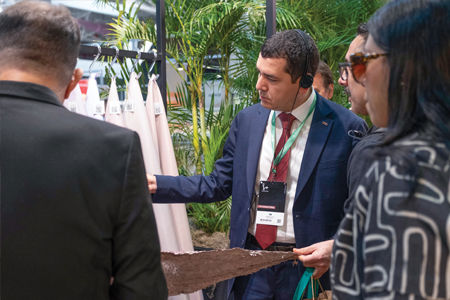
These changes have made the part of Turkish footwear manufacturers’ lives that involves sourcing leather more challenging. A delegation of senior representatives of the leather and footwear sector in Turkey travelled to Porto Alegre in January 2026 to inspect leather and other materials at the Inspiramais exhibition. Buyers’ delegations from Mexico, Colombia, Ecuador, Peru, Chile and other places in Latin America are always present at Inspiramais. This was the first time a delegation from Turkey had attended. It was led by the president of the Turkish Footwear Industrialists’ Association, Berke Içten.
The group has confirmed to Footwearbiz that the footwear sector in Turkey is serious about sourcing increased volumes of leather from Brazil. Mr Içten says Turkey currently has the capacity to produce 550 million pairs of shoes and other footwear per year. His calculation for 2025 is that manufacturers were operating at 80% of capacity and produced around 450 million pairs.
He insists Turkey still has good domestic production of leather, but argues that the “steady volumes and good prices” of material from Brazil will complement this well.
The president of the International Union of Shoe Industry Technicians (UITIC), Sergio Dulio, says he thinks it makes sense for Berke Içten and his colleagues to have travelled to Brazil to hold in-depth discussions about sourcing leather from tanners there. He thinks a strong Turkish presence at the Micam exhibition in Milan in February was indicative of “a good growth trajectory” for footwear manufacturers in Turkey. Around 50 Turkish footwear companies took part. “Their factories need raw material,” Mr Dulio explains. “It makes sense for the industry to cast its net a bit more widely.”
President of the Turkish Footwear Industrialists’ Association, Berke Içten, inspecting Brazilian leather at Inspiramais in Porto Alegre. Credit: Inspiramais






