



Ecco trials leather waste fibre
The Danish brand has shown that wet blue shavings can be transformed into new material through its longstanding partnership with Spinnova.
When Ecco first explored turning leather-production waste into textile fibre, the idea was largely experimental. Several years on, the concept has reached a footwear application in a limited-edition model, the Biom 720.
The project, launched in 2021 with cellulosic fibre specialist Spinnova and then-partner KT Trading, was designed to investigate whether wet-blue leather waste could be converted into usable textile fibre for spinning, weaving and knitting. At the time, the aim was around extending the value of existing material streams, rather than replacing them. Following successful pilot trials, the partners confirmed plans to explore commercialisation and assess a first industrial-scale production set-up, initially earmarked for the Netherlands, where Ecco Leather’s operations are based.
By 2024, the companies had formalised their intent to scale the venture through a letter of intent covering the Respin joint venture, alongside confirmation that fibre quality had reached commercial requirements. Ecco also produced an early prototype shoe using material from the pilot line, marking the first step towards footwear application.
“Together, we have shown that leather waste can be transformed into a high-quality textile fibre with commercial relevance,” said Spinnova chief executive officer Janne Poranen, describing the development as the outcome of several years of joint work.
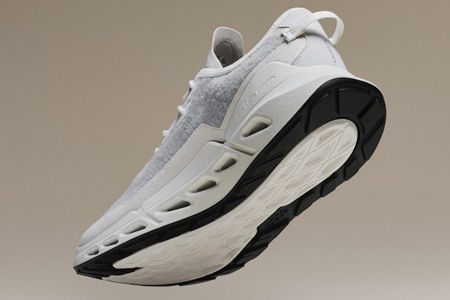
The latest Biom 720 release represents the first limited edition footwear application of the fibre. The material is produced from wet blue shavings, a by-product generated during chrome tanning when thin layers are removed from hides to achieve a consistent leather thickness. For this launch, Ecco confirmed the shavings were sourced from its tannery in Dongen, the Netherlands. Following the previously announced closure of the Dongen site after a fire in 2025, the company indicated that future sourcing could also include its Asian operations as well as the potential to use other European tanneries.
Fibre technology
Spinnova’s technology uses a mechanical refining process rather than chemical hydrolysis to convert the shavings into continuous filaments, which are then cut into textile-grade fibres for use in woven and knitted applications. The company says the process also enables multiple waste streams, including wood, textile and agricultural residues, to be used without the need for harmful dissolving chemicals or production side streams.
Spinnova has previously described Respin as a way to “keep leather in circulation” by upcycling waste into new textile fibres, positioning the material within a broader circular economy framework for the leather value chain. The company has also noted that once processed, the fibre behaves more like a textile input than a leather-derived material, with some performance characteristics linked to its origin but without retaining the structural network of the original hide.
Ecco has similarly mirrored this distinction. In response to technical questions, the company said the original collagen structure of leather is no longer present after processing, with the fibre instead representing a physical transformation of a by-product into a new textile material.
“By combining our expertise with Spinnova’s technology, we are exploring new ways of using existing resources in footwear,” said Ecco chief executive officer Thomas Gøgsig, pointing to material innovation as part of future product development.
Scalable production
The Biom 720 itself builds on Ecco’s biomechanical footwear platform, designed to support natural movement with a close-to-the-ground profile. It also integrates Ecco encore technology, with outsole ventilation features intended to improve breathability, energy return and shock absorption.
While the footwear application provides a visible milestone, the wider significance of the project lies in its attempt to establish a scalable route for leather production waste. Spinnova has previously reported that wet blue shavings from European tanneries, including Ecco’s own facilities, were used during early pilot work, helping to establish initial proof of concept for the process.
In the current phase of development, however, the companies told Footwearbiz that work has been based exclusively on Ecco wet blue shavings. This controlled input approach has been used to maintain consistency during pilot optimisation and to better understand process behaviour before introducing wider variability at industrial scale.
For Ecco, the introduction of the fibre into footwear represents a transition into product-level testing in a controlled, limited format. For Spinnova, it provides further validation of its mechanical fibre technology beyond its original wood-based applications.
The companies also noted that the fibre remains in a pilot phase, with development work aimed at preparing for future commercial rollout. They added that fibre quality is sensitive to both raw material variation and process conditions, with early-stage work conducted under tightly controlled parameters.
The fibre is not currently positioned for direct cost comparison with conventional textile materials such as wool, polyester or cotton, with commercial viability expected to depend on scale and end-use application rather than immediate price parity. Internal preliminary environmental assessments have been conducted during pilot development, alongside testing against Ecco’s internal quality performance standards for footwear applications. Looking ahead, key questions remain around feedstock variability, the integration of external tannery waste streams and how a multi-supplier model could be managed in practice. These factors are expected to shape the next phase of development as Respin moves from pilot validation towards broader industrial application.
ECCO Biom 720 with Spinnova fibre. Credit: Ecco/Respin






