



Reclaiming a lost material
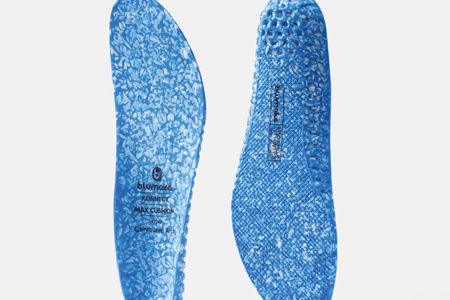
Made with 85% recycled product, Blumaka’s insoles and midsoles can help footwear brands find a use for foam waste while boosting comfort and durability. Anti-slip technology and carbon plates are taking performance to an extra level.
Chronic injury can be career ending for many athletes, and US national team lacrosse player Trevor Baptiste thought turf toe was a pain that would mar his entire professional life. When the foot slides inside the shoe, particularly during turf sports, the big toe (metatarsophalangeal or MTP) joint can sprain or bruise due to the upward bending. Baptiste had tried shoes a size too small, but the constant jamming of his feet made the injury worse. Being introduced to Blumaka’s insoles with their propriety non-slip technology was a “turning point”, he says. “The non-slip changed how secure I feel in my shoes.”
But the company didn’t start out on a mission to tackle foot comfort and injury – its first mission was to tackle waste. Co-founder Stuart Jenkins has seen many developments during his decades-long career in the footwear industry through previous roles, such as senior vice-president of innovation at Deckers Brands and CEO at Shoes for Crews. During visits to shoe factories in Asia, he was always struck by the vast amount of leftover foam heading for landfill or incineration: enough to make 5 billion insoles or 2.5 billion midsoles per year, according to some estimates. This high-quality material was going to waste. In 2019, he teamed up with Joe Skaja, who led the team that created the Nike Air sole, and manufacturing expert Chantal Herry to create a new product stream, at a new solar-powered factory in China and a new use for this material.
Over three years, and working with companies such as Huntsman, they developed the process. Waste foam is ground into granulated particles and mixed with PU to create the midsole unit. A special TPU film is then used, creating insoles and midsoles with 85% recycled content. In theory, the recycled materials could include any foam that can be chopped up: EVA, PU, biofoam, Bloom, ETPU, Poron, TPE-E, TPU, Styrofoam, silicone or neoprene.
Adding a high percentage of recycled material is often associated with a lower-performing product, but it is exactly these flecks of foam that make the material so comfortable, marketing manager Charley Hoffman tells Footwearbiz. Rather than a straight EVU foam, the ground-up pieces create air bubbles, which increase comfort and durability. “When you encase little pellets of foam in a film, it becomes stronger, because when one of these little cushion units fails, the next one picks up the slack,” he says, noting Skaja had been instrumental in this discovery in the 1990s.
But converting big brands to the recycled foam was not going to be as easy as first imagined, even with the team’s strong footwear connections. They faced resistance against switching suppliers and a hesitance towards new manufacturing techniques, even if it could be proven to have a lower environmental impact, with the manufacturing process using no silicone and far less water than conventional foam-making. The company sought a new avenue: direct to consumer.
Running circuit
Jenkins, a dedicated runner who once trialled for the Olympics, was unhappy about spending thousands of dollars on shoes and insoles as they wore out. Shoe manufacturers often prioritise the more marketable midsole technology, outsole and the upper, he says, while the insole receives less design and engineering attention. “The dirty little secret of most running shoes is that they go flat or lose their cushioning in about 200 miles. When I was training 100 miles a week for the Olympic trials marathon, I needed a new pair of shoes every two weeks,” he says. “That was until I invented the Blumaka insole.”
This insight meant the first market to really adopt Blumaka were trail runners. Runners face unpredictable terrain and sudden shifts in movement, and a foot that slides even slightly in the shoe can cost stability and increase injury risk. The team attended running events and speciality retailers, promoting the non-slip benefits and durability: tests showed the insoles were good for 1,000 miles. Next, sports where foot stability is paramount: baseball, American football, pickleball and lacrosse. An independent study of more than 200 professional athletes revealed 80% improved their start/stop speed, 90% ran faster and 80% reported improved lower-body stability from the knee down. Blumaka says tens of thousands of athletes now choose the insoles.
Trainers’ end
Addressing waste, lowering the carbon footprint and making durable products are key sustainability tenets in the footwear industry, but recycling post-consumer shoes has always been difficult. The complexity of shoes – with their multitude of materials and glues, plus shipping the waste around the world to facilities with the right capabilities, inceased the carbon footprint and negated the environmental benefits. However, companies such as Fast Feet Grinded in the Netherlands and Sneaker Impact in Miami can grind shoes down to granules of rubber, EVA foam, TPU foam, PU foam and textiles, ready to be supplied to other sectors. Blumaka believes US manufacturing of the insoles could work, with enough orders in the region of 15,000 per month. “We can take Sneaker Impact’s foam and, using our process, turn old running shoes into new shoes or components,” says Hoffman. “Right here, there's a solution.”
The new shoes he mentions include sister company Fleks Footwear. When Jenkins told former Deckers colleague Leah Larson about the plan to create the foam, she immediately saw its potential for flip flops and slides. “What better material to use for beach sandals than a material that protects the ocean by diverting plastic from the waste stream?” she says. At the end of last year, the shoes received a huge credibility boost: Oprah Winfrey included the San Ysidro Slide on her ‘favourite things’ list.
Brand take-up
Brand adoption is growing. Alongside pickleball brand Daps, baseball-focused SQAIRZ, running specialist Run Rabbit and safety footwear brand SR Max, Allbirds last September launched a Remix collection using Blumaka midsoles, and was the first footwear brand to use Circ’s textile-to-textile recycled materials derived from polycotton waste.
Last summer, Blumaka released the Carbon Elite, built around Carbitex’s GearFlex G3 carbon fibre plate. This plate flexes naturally as you run but stiffens throughout the gait cycle, which stops over-rotation of the MTP joint but still enables natural running – a development to address turf toe and which is now being used by the National Football Leage (NFL). “So much time is spent on the outsoles of shoes, making sure you’re not sliding on a football field or your cleat doesn't slip in the turf or the grass, but every time an athlete cuts or changes direction, their foot slides inside their shoe,” adds Hoffman. “Grip socks are a big thing, but they don’t really solve the problem. There’s nothing else in the market like our non-slip technology.”
Next in the portfolio will be another insole with an integrated carbon plate – this time a more rigid one, again aimed at the NFL. Blumaka is also aiming to grow its sports partnerships – with tests showing promising results for golfers, for example – as well as retailers, with the product available on its website, sports retailers and Amazon. “We don’t recycle trash, we reclaim the most advanced foam ever made and improve upon it,” says Jenkins. “Our process shows that waste foam isn’t a problem, it’s an opportunity.”
High-friction insole surfaces increase grip between the foot and the insole, reducing internal foot movement. Credit: Blumaka






