


A decade of discoveries
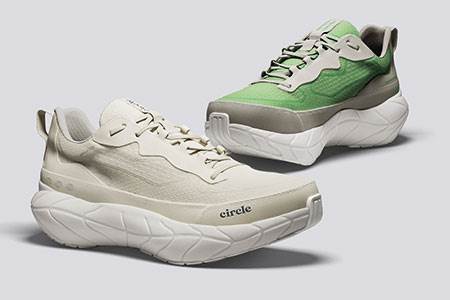
Lenzing’s innovations in the footwear sector means its wood-based products have multiple uses for shoes, with Circle Sportswear the first to use its lyocell filament for an upper.
“I had no idea lyocell and Tencel were made from wood when I first started designing a shoe,” admits Circle Sportswear’s co-founder and creative director, Solene Roure. “We talk so much about them in the industry, but most people don’t know what they’re made of.”
Partnership purpose
This year marks 10 years since Austria-based Lenzing made its first forays into the footwear sector, and the occasion was marked at the most recent Future Fabrics Expo in London with the launch of three novel shoes underpinned with its fibres. French brand Circle presented the SuperNatural Runner, which uses an upper blended with 50% lyocell – the first time it has been used in a filament form in this way by a footwear brand. Solk presented a “compost compatible” shoe (see separate feature) with Lenzing fibre laces, and Modern Synthesis produced a concept shoe called Korvaa, with the upper ‘grown’ from nanocellulose, with Lenzing's lyocell used in a non-woven form to provide structure.
Lenzing’s Tencel lyocell and modal are regenerated cellulosic fibres made from wood. The wood pulp is dissolved – the lyocell production process only uses an organic solvent, and the recovery rate is more than 99 percent – then cellulosic fibres are produced in the appropriate shape, length and diameter for the application. The company’s fibres are known for adding softness and comfort in clothes – not attributes usually associated with shoes – and this leads to misconceptions, its head of technical developments, Nicole Schram, tells Footwearbiz. “It would not be the first material people think of for footwear, because it’s so well positioned as a soft and cosy material, with next-to-skin properties,” she says. “But it really depends on the construction. It’s my job to think about application development, how the materials blend and how they scale.”
While currently a small proportion of Lenzing’s sales, the applications in the footwear sector are “very innovative”, she tells us. As well as being used for shoe uppers in a woven or non-woven form, its products can be used in laces, insoles, linings, zips and sewing threads, and even blended into outsoles in a powder form.
Lenzing says the lyocell filament yarns are among the strongest cellulosics and that they have a high tenacity profile, which enables them to withstand fast production speeds. “Tencel fibres and filaments are a good match for the footwear industry as they offer thermal regulation and moisture management as well as sustainability credentials, such as biodegradability and traceability,” Schram commented at Future Fabrics Expo.
Circle for Circle
Incoming regulations and pressure for less impactful products mean circular options are increasingly sought after, particularly given the difficulties around recycling shoes. This was one of the appeals of Tencel for Circle when it came to producing its first shoe. The team wanted to approach footwear design in a new way, and after working for four years with suppliers, produced a product that is 75% natural materials. “The turnaround of running shoes is insane, and there is no second-hand market, so it normally just goes to landfill and turns into microplastics,” explains Ms Roure. “I wanted to show sustainability can be more exciting, and I wanted to bring the joy back.”
The shoe’s upper is 50% wool and 50% lyocell filament. To create it, Lenzing worked with Coats Footwear, formed following the merger of Texon and Rhenoflex in 2023, using Texon’s ProWeave jacquard technology. The technique makes it possible to integrate multiple functions into a single sheet of material, creating different elasticity, tenacity and abrasion zones within the same weave.
The external reinforcements in the SuperNatural Runner, the eyelets and foxing, the strip securing the joint were upper and cell meet, are made from Mirum, a non-woven produced in the US using natural rubber, plant oils and natural pigments. The laces are made from organic cotton while the insole is made in Portugal from natural fibres, natural rubber and merino wool. The midsole is made from with 45% bio-based content from castor beans using a supercritical foaming process while the outsole is made from 70% bio-based rubber.
There are also minimal adhesives with no heat-bonded components. At the end of its life, its adhesive can be reheated, allowing for easier disassembly. “The disassembly part is a concept at this point as the shoes are new,” admits Ms Roure, “but it was designed to make this easier. We want it to be separated into three parts and we are testing this with partners. We won’t crack the recycling on our own, but when the systems are in place, our shoe won’t be difficult to take apart.”
The companies at Future Fabrics did not specifically mention their coatings, but one would be necessary if the shoes are to be made waterproof. There are many on the market, as well as bio-based offerings, for instance from Germany’s Rudolf, which would not detract from the biodegradable and natural stance.
Partners push progress
Ms Roure speaks highly of working with Lenzing’s team on the journey to finding the right materials, and Ms Schram echoes that working with footwear brands has also led to novel uses of its fibres: previous tie-ups include with Recyc Leather for a material that fuses lyocell with recycled leather in Danish brand Ganni’s slouchy boot, and a project with Ananas Anam, which makes fibres from pineapple leaf waste, creating the Sustainable Knit Trainer for Calvin Klein.
Adidas and Allbirds also selected an upper made with 30% Tencel for their Futurecraft.Footprint launched in 2021 – a running shoe with a CO2 footprint of just 2.3 kilograms per pair.
“We find collaborations very inspiring, and we always work with companies that match our philosophy and business model,” concludes Ms Schram, adding that each collaboration boosts research and development and opens new avenues and new solutions. “You can’t be an expert in everything – we have massive expertise in fibres, but we need partners to make these products happen.”
The SuperNatural Runner is made with 75% natural materials. “We’ve had lots of successes in this shoe, and we’re happy to share these with the industry,” says Circle Sportswear co-founder Solene Roure.
Credit: Circle Sportswear






