



Sustainability race
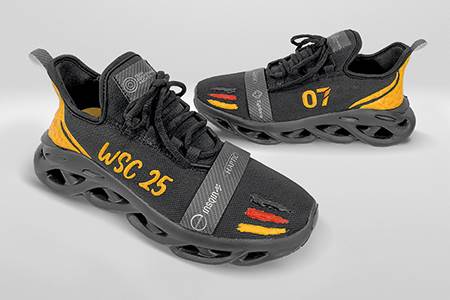
Covestro has been working with Huafeng since 2023 on what the partners have called a ‘sustainability transformation’. Fruits of the partnership now include footwear that a team from Germany wore in a special car race this August.
Close partnership between polymer materials company Covestro and textiles technology group Huafeng has been going on for two years now. Their work together recently delivered high-performance, more sustainable footwear for Team Sonnenwagen Aachen to wear during the 2025 Bridgestone World Solar Challenge in Australia. This event is a race for solar-powered cars, designed and driven by university teams from different parts of the world. This year, cars left Darwin on August 24 to drive more than 3,000 kilometres to Adelaide. The team from Aachen finished fourth overall with a time of just over 36.5 hours.
Partnership purpose
Team Sonnenwagen Aachen was one of more than 50 teams in the race this time, driving a car called the Covestro Aethon. The teams represent internationally renowned universities, including, in this case, RWTH Aachen University and FH Aachen, with the aim of promoting and publicising research and development in the field of solar mobility, pushing the boundaries of what is possible in more sustainable transport.
Based in Leverkusen, just 100 kilometres away from RWTH Aachen, Covestro has sponsored Team Sonnenwagen Aachen since 2017. For the 2025 event, it invited Huafeng to take part, too, with a view to intensifying their commitment to sustainability, with a particular focus on developing high-performance footwear. The shoes that have come out of this joint effort have a significantly reduced environmental impact, with no compromise on quality or functionality, Covestro has stated.
Mounting pressure
“The footwear industry faces mounting pressure to reduce its environmental footprint while maintaining high performance standards,” the polymer materials company continues. “While waterborne solutions have already made significant strides in reducing emissions compared to solvent-based alternatives, the industry is now facing additional challenges.” It lists the main ones as further reducing carbon emissions across manufacturing processes, increasing the use of bio-based content and recycled materials, maintaining durability and performance standards under extreme conditions, meeting growing consumer and regulatory demand for more sustainable products, and achieving all of these goals without compromise on design capabilities or performance.
The footwear that Huafeng developed, using Covestro’s partially bio-based PU dispersions for the printing inks, for Team Sonnenwagen to wear in the 2025 World Solar Challenge directly addresses these challenges, the partners insist, and could offer a blueprint for the future of athletic footwear manufacturing.
Shoe design and materials
The uppers in the shoes for Team Sonnenwagen were produced using 100% recycled polyester yarns from Huafeng’s yarn partner Cyclone. These materials come from PET bottles collected in Fujian and other nearby Chinese provinces, utilising plastic waste that might otherwise end up in landfill or even in the marine environment.
Huafeng has used the yarns to develop a special lightweight material that allows shoe construction largely without additional lining material. This approach reduces the overall weight of the polyester material by approximately 30%, resulting in what Covestro has called “significantly higher material efficiency” compared to the shoes the Aachen team used during the last edition of the race in 2023.
Advanced manufacturing processes
The environmental benefits extend beyond materials to encompass the entire manufacturing process, the polymer materials company continues. The fabric used in the shoes is manufactured on modern knitting machines powered by approximately 50% solar energy. This solar energy is generated directly from panels installed on the factory roof, creating a fitting synergy with Team Sonnenwagen’s solar racing mission.
Arguably the most innovative part of production is the colouring process. Cyclone uses a dope-dyeing process for its rPET yarns, reducing the volumes of wastewater typically generated during dyeing. Compared to traditional dyeing techniques, this dope-dyeing technology saves 57% energy, 77% water, and reduces carbon emissions by 51% throughout the process. These figures come from a 2021 assessment of Cyclone’s operations that testing, inspection and certification provider SGS carried out.
Bio-based customisation
Customisation in footwear manufacturing represents a growing market trend, and the Team Sonnenwagen shoes showcase how this can be achieved more sustainably. Huafeng’s Haptic Art ink is used to decorate the shoes, enabling artistic and three-dimensional colour effects on the finished product.
The Haptic Art ink is made using partially bio-based Impranil CQ polyurethane dispersion, which belongs to the waterborne Insqin textile coating technology from Covestro. It says this results in approximately 50% bio-carbon content in the dried ink. No other resins are blended in. The partially bio-based Impranil has a 38% lower carbon footprint compared to standard grade Impranil, it points out, demonstrating how partially bio-based alternatives can reduce a product’s carbon footprint without compromising on quality or aesthetic possibilities. This percentage comes from in-house calculations Covestro has conducted.
Under extreme conditions
The World Solar Challenge presents some of the most demanding conditions for both vehicles and team members. Temperatures in the Australian outback can reach extreme levels, even in winter, and team members need gear that can withstand these conditions while providing comfort and protection.
The lightweight, breathable construction of the footwear developed for Team Sonnenwagen addresses these challenges directly. The elimination of unnecessary lining material not only reduces weight and material usage but also enhances breathability, crucial for maintaining comfort in high-temperature environments. In addition, the shoes, in the words of Team Sonnenwagen Aachen’s head of marketing, Charlotte Teckentrup, “look awesome”. She adds: “We are proud to race with the support of Huafeng, Cyclone and Covestro because they really care about sustainability, just like we do.”
Holistic approach
While footwear represents the centrepiece of the collaboration, it forms part of a comprehensive solution for more sustainable sportswear. Huafeng also provided the team with shorts and trousers that are primarily made of rPET, with small amounts of stretch yarn for enhanced comfort. The design is applied to the clothing by screen printing Huafeng’s Haptic printing paste, which also contains the partly bio-based Impranil CQ polyurethane dispersion.
The steering wheel of the solar vehicle itself features a textile coating based on the partially bio-based Impranil CQ products, demonstrating how more sustainable textile solutions can extend beyond sportswear to functional components.
This holistic approach showcases how enhanced sustainability can be integrated throughout a team’s equipment and vehicle components, the partners say, creating a comprehensive solution that addresses environmental concerns at multiple levels.
Industry standards
The collaboration between Covestro and Huafeng for Team Sonnenwagen could be a demonstration of how the wider footwear industry can respond to increasing demands for sustainability without compromising on performance or design. By combining recycled materials, partially bio-based components, more energy-efficient manufacturing and innovative construction techniques, the partnership has created athletic footwear that can serve as an example to others.
“We are delighted that Impranil CQ is part of Huafeng’s innovative textile coating solutions,” says Dr Torsten Pohl, head of global textile coatings at Covestro. “This demonstrates the rich potential for sportswear manufacturers to design customised products with a reduced carbon footprint.”
For Dr Thomas Schmidt, director of innovation at Huafeng, putting partially bio-based Impranil CQ solutions into an innovation such as the Haptic Art ink offers extensive customisability of high-performance textiles for use in shoes, sportswear and other products.
Huafeng used partially bio-based Impranil CQ polyurethane dispersion products from Covestro to develop the ink that makes customisation of shoes and apparel more sustainable.
Credit: 2025 Huafeng






